
Is Australia Finally Getting a Bill of Rights in 2026? Not So Fast
Summary
A federal Human Rights Bill is back before parliament and the coverage has reached for the phrase 'bill of rights'. Three questions cut through the noise. What is it? Will it rock the boat? What would it actually do? In short, it is narrower than its billing and would put no obligation on business. The one feature that would genuinely change things, the power to strike out inconsistent laws, is also the reason it faces a hard path through parliament. The legislation that actually binds business is anti-discrimination law, and the Commonwealth positive duty on employers is in force now.
Key Takeaways
- The Human Rights Bill 2026 (Cth) is a private member's bill, not a constitutional charter. It imposes no human rights duties or liability on business and would operate through the interpretation and invalidity of legislation and a complaints process directed at government.
- Its one genuinely novel feature, the power to strip an inconsistent law of effect, is also why it faces a hard path through parliament without government support.
- The legislation that binds business is anti-discrimination and sexual harassment law: the Anti-Discrimination Act 1991 (Qld) and, federally, the Sex Discrimination Act 1984 (Cth).
- Giggle for Girls Pty Ltd v Tickle [2026] FCAFC 64 confirmed that a private company can be ordered to pay damages for gender identity discrimination, which is where the real exposure for business sits.
- Queensland has paused its positive duty pending a review, but the equivalent Commonwealth positive duty has bound Queensland employers since 12 December 2023. The pause is not permission to delay.
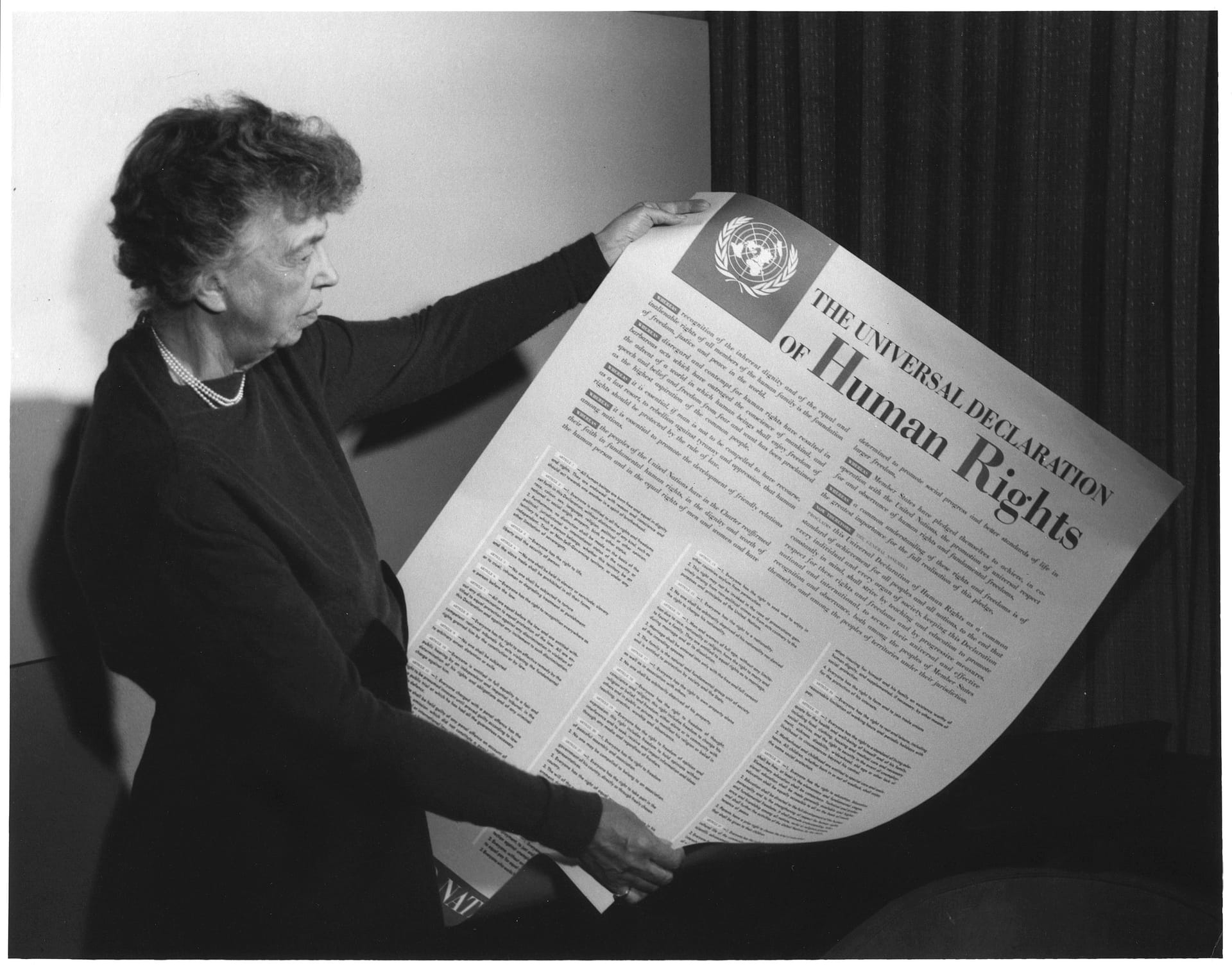
Image: Eleanor Roosevelt with the Universal Declaration of Human Rights, 1949. Franklin D. Roosevelt Presidential Library & Museum.
A federal Human Rights Bill is back before parliament and the coverage has reached for the phrase 'bill of rights'. Three questions cut through the noise. What is it? Will it rock the boat? What would it actually do? In short, it is narrower than its billing and would put no obligation on business. The one feature that would genuinely change things, the power to strike out inconsistent laws, is also the reason it faces a hard path through parliament.
In Brief
- A private member's Human Rights Bill 2026 (Cth) was introduced into federal parliament on 25 May 2026, proposing Australia's first national Human Rights Act. It would impose no human rights duties or liability on business, operating instead through the interpretation and invalidity of legislation and a complaints process directed at government. As a crossbench bill without government support, its path is uncertain.
- The 'bill of rights' label oversells it. This would be an ordinary statute, not an entrenched constitutional charter. Clause 13 means a breach of the rights carries no remedy in damages.
- In Queensland, the Government announced on 11 June 2026 a review of the state's human rights and anti-discrimination framework, led by the Honourable Peter Flanagan KC, with a report due by 31 March 2027.
- The legislation that binds business is anti-discrimination and sexual harassment law, not the human rights statutes. In Queensland, that is the Anti-Discrimination Act 1991 (Qld). At the federal level it is the Sex Discrimination Act 1984 (Cth).
- The direct liability that discrimination law imposes on business was confirmed in Giggle for Girls Pty Ltd v Tickle [2026] FCAFC 64, where the Full Court of the Federal Court held a women-only app operator liable for gender identity discrimination.
- Queensland enacted a positive duty on employers in the Respect at Work and Other Matters Amendment Act 2024 (Qld), but the Government paused it before commencement. Its future is now part of the review.
- The pause does not clear the field. The equivalent Commonwealth positive duty under the Sex Discrimination Act 1984 (Cth) has been enforceable since 12 December 2023 and already applies to Queensland employers.
The Federal Bill
On 25 May 2026 the Independent member for Clark, Andrew Wilkie, introduced the Human Rights Bill 2026 (Cth), seconded by the Independent member for Indi, Helen Haines. It proposes a national Human Rights Act, a statutory set of rights and freedoms drawn from Australia's international treaty obligations, including the International Covenant on Civil and Political Rights and the International Covenant on Economic, Social and Cultural Rights.
Two things deflate the headline before the detail. The label oversells the instrument. This would be an ordinary Act of Parliament, able to be amended or repealed like any other, not an entrenched constitutional charter of the kind the United States has, so Australia would still have no bill of rights in that sense. The Bill also adds nothing to parliamentary scrutiny, which is the part many assume is the point. Statements of compatibility with human rights have accompanied every federal bill since 2012 under the Human Rights (Parliamentary Scrutiny) Act 2011 (Cth). Wilkie's own Explanatory Memorandum carries one. That machinery already exists.
The Bill's mechanics are unusual and worth stating precisely. Under clause 11, any Commonwealth, state or territory law that is inconsistent with the protected rights has no force or effect to the extent of the inconsistency, subject to an override declaration that lapses after two years. Under clause 12, all legislation must be interpreted consistently with those rights so far as possible. Part 3 expands the role of the Australian Human Rights Commission, which may inquire into an act or practice that may infringe a right and either conciliate it or report to the Minister. Clause 13 is the critical one. It provides that nothing in the Act makes any person liable in civil or criminal proceedings for an act that infringes a human right. The Bill creates no human rights duty and no cause of action against anyone.
On the statute book this is a strong model. Where the Victorian, Queensland and ACT charters allow a court only to declare a law incompatible while the law stays in force, this Bill would strip an inconsistent law of effect. It reaches state and territory laws as well as Commonwealth ones, which raises questions about both the relationship between the courts, parliament and the executive and the limits of Commonwealth power. On private actors the Bill is weak by design. It imposes no obligations on business. The complaints process is confined to acts and practices of the Commonwealth, the states, the territories and their authorities, as clause 4 defines those terms. Clause 18 provides that only individuals, not companies, hold the rights. A business is touched only indirectly, through the way the laws that regulate it are read and whether those laws keep their force.
The other reason for caution is political. This is a private member's bill from the crossbench. It is the third attempt at a federal Act. The government has not committed to one. A bill of this kind does not become law without government support. For business, the federal Bill is a matter to monitor, not to act on.
How It Compares Internationally
Set against comparable instruments, the Bill is an outlier.
| Instrument | Type | Can it strike down a law? | Duty on public authorities? | Damages for a breach? |
|---|---|---|---|---|
| Human Rights Bill 2026 (Cth) | Statutory | Yes, the law loses force, subject to a two-year override | No | No |
| Human Rights Act 1998 (UK) | Statutory | No, a court may only declare a law incompatible | Yes | Yes, as a last resort |
| New Zealand Bill of Rights Act 1990 | Statutory | No | Reviewable | Yes, developed by the courts |
| Charter of Human Rights and Responsibilities Act 2006 (Vic) | Statutory | No | Yes | No |
| Human Rights Act 2019 (Qld) | Statutory | No | Yes | No |
| Canadian Charter of Rights and Freedoms | Constitutional | Yes | Yes | Yes |
| United States Bill of Rights | Constitutional | Yes | Yes | Yes |
| South African Bill of Rights | Constitutional | Yes | Yes | Yes |
The pattern is the point. The overseas statutory schemes cannot strike down a law, but each gives a person something against the actor, whether a duty on public authorities or an award of damages. The constitutional charters give both. This Bill is the reverse. It is the only one of them that can render a law inoperative. It is also the only one that hands the individual no duty to enforce and no remedy in damages. It disciplines laws. It does not put a remedy in the hand of the person whose right was infringed.
For business the distinction is the whole point. A human rights statute of this kind creates no claim against a company. The law that does is anti-discrimination law. It carries the remedies the Bill lacks. As the discrimination decision discussed below shows, a private company can be ordered to pay damages, which is where the real exposure for business sits.
One content point deserves drawing out, because it has gone largely unremarked. The Bill's list of rights is broad, broader than most of the instruments above, reaching into health, education, housing, work, social security and even a right to a healthy environment. Yet it contains no right to property. That partly follows from its treaty base. The International Covenant on Civil and Political Rights protects no property right. Neither the United Kingdom Act nor the Canadian Charter includes one either. The United States Bill of Rights, the European Convention and the South African Constitution all do. Its absence is a deliberate choice and a striking one for a document marketed as a bill of rights, since protection of property is exactly what many people assume such a document delivers.
The Queensland Review Behind It
The more immediate development is in Queensland. On 11 June 2026 the Government announced a review of the state's human rights and anti-discrimination framework and appointed the Honourable Peter Flanagan KC, a former judge of the Supreme Court of Queensland and the Court of Appeal, to lead it. The review comprises three separate reviews conducted by a single reviewer, with a report due to the Attorney-General and the Human Rights Commissioner by 31 March 2027 and draft legislation to be included where appropriate.
The first is a strategic review of the Queensland Human Rights Commission under s 247 of the Anti-Discrimination Act 1991 (Qld). The second is a further review of the Human Rights Act 2019 (Qld) under s 96, considering whether to add rights drawn from international instruments, whether to alter the remedies available when a public entity acts unlawfully and how the Act interacts with the Corrective Services Act 2006 (Qld) and the Youth Justice Act 1992 (Qld). The first independent review of that Act was tabled in March 2025 and the Government agreed not to implement its recommendations, so this is the second review of the framework in a short period. The third is the most significant for business: a review of the uncommenced provisions of the Respect at Work and Other Matters Amendment Act 2024 (Qld).
The Legislation That Binds Business
It is commonly assumed that human rights legislation is directed at government rather than private enterprise. For the Human Rights Act 2019 (Qld) and the proposed federal Act, that is broadly correct. Neither imposes human rights obligations on ordinary private business.
Anti-discrimination law is different. The Anti-Discrimination Act 1991 (Qld) applies directly to business. It renders discrimination unlawful in employment, in the supply of goods and services, in accommodation and in other areas of public life. It makes employers vicariously liable for discrimination and sexual harassment by their staff. Complaints are made to the Queensland Human Rights Commission. This is the legislation that gives rise to direct liability for business. It sits at the centre of the review.
The same exposure exists at the federal level. The Sex Discrimination Act 1984 (Cth) makes discrimination on grounds including sex, sexual orientation and gender identity unlawful in the provision of goods and services. It binds the businesses that provide them. The reach of that liability was confirmed in Giggle for Girls Pty Ltd v Tickle [2026] FCAFC 64, in which the Full Court of the Federal Court held that the operator of a women-only social media application had directly discriminated against a transgender woman by excluding her on the basis of her gender-related appearance, contrary to ss 5B(1) and 22 of that Act. The Court increased the damages to $20,000, including $8,000 in aggravated damages referable in part to the manner in which the case was conducted and to related public commentary.
Three points from the decision are instructive for business. The protection extends to a person's gender-related appearance, not only their stated identity. A respondent's genuine belief that the person was not a woman did not prevent a finding of discrimination. The special measures provision, which permits measures taken to achieve substantive equality between men and women, did not authorise discrimination on another ground, so the women-only character of the service was no answer to a claim of gender identity discrimination. The Court was careful to record that it was construing the statute, not expressing a view on the wider social debate.
In 2024 the Queensland Parliament substantially amended that Act. The Respect at Work and Other Matters Amendment Act 2024 (Qld) introduced a positive duty requiring employers to take reasonable steps to eliminate discrimination, sexual harassment, harassment on the basis of sex and other objectionable conduct so far as possible. The positive duty marks a move from a reactive, complaints-based model to a preventative one. It requires employers to take steps to prevent the conduct rather than to respond after a complaint is made. Most of those reforms were due to commence on 1 July 2025. In March 2025 the Government paused them, citing concerns that the Act had been passed in the final days of the previous government's term and that some features, such as a new protected attribute of irrelevant criminal record, could affect sensitive licensing decisions. Commencement was deferred to a date to be fixed by proclamation. The provisions remain uncommenced. Their future now sits with the review.
The Pause Does Not Remove the Obligation
Employers should not treat the pause as a reason to defer action. The Queensland positive duty is paused. The Commonwealth equivalent is in force. Since 12 December 2023 the Australian Human Rights Commission has had power to enforce a positive duty under the Sex Discrimination Act 1984 (Cth). It requires employers and other persons conducting a business or undertaking to take reasonable and proportionate measures to eliminate sex discrimination, sexual harassment, sex-based harassment, hostile workplace environments and related victimisation so far as possible. It applies to Queensland employers now, whatever the State does with its own version. Work health and safety law adds a further layer, requiring employers to manage psychosocial risks, including sexual harassment, as workplace hazards.
The practical position is therefore clear. The proactive obligation exists at the Commonwealth level today. The paused State duty indicates the direction the State intends to take. An employer that treats the pause as permission to delay remains exposed under the Commonwealth duty in the meantime.
What Businesses Should Do
The federal Bill should be monitored rather than acted on. The Queensland review is the more significant local development, because it will shape the Anti-Discrimination Act 1991 (Qld) and the future of the positive duty, with a report due by March 2027. In the meantime, employers should ensure they meet the Commonwealth positive duty under the Sex Discrimination Act 1984 (Cth), because it binds them now.
If you would like a clear read on what the positive duty already requires of your business and where your current policies and training sit against it, please get in touch or call (07) 3519 5616.
Sources and References
- LegislationHuman Rights Bill 2026 (Cth)
- LegislationHuman Rights (Parliamentary Scrutiny) Act 2011 (Cth)
- LegislationSex Discrimination Act 1984 (Cth)
- LegislationAnti-Discrimination Act 1991 (Qld)
- LegislationRespect at Work and Other Matters Amendment Act 2024 (Qld)
- LegislationHuman Rights Act 2019 (Qld)
- Case lawGiggle for Girls Pty Ltd v Tickle [2026] FCAFC 64
This article is for general information purposes only and does not constitute legal advice and should not be relied on as such. While we take reasonable care to ensure the accuracy of the information provided, we make no representations or warranties as to its completeness, currency or reliability. We accept no liability for any loss or damage arising directly or indirectly from the use of, or reliance on, this website's content. You should always seek professional advice tailored to your specific circumstances before acting on any information in this article. Liability limited by a scheme approved under Professional Standards Legislation.
Do you meet the positive duty?
The Commonwealth positive duty binds Queensland employers now, whatever the State does with its own version. Astris Law can assess where your policies and training sit against it. Book a call back on (07) 3519 5616.